


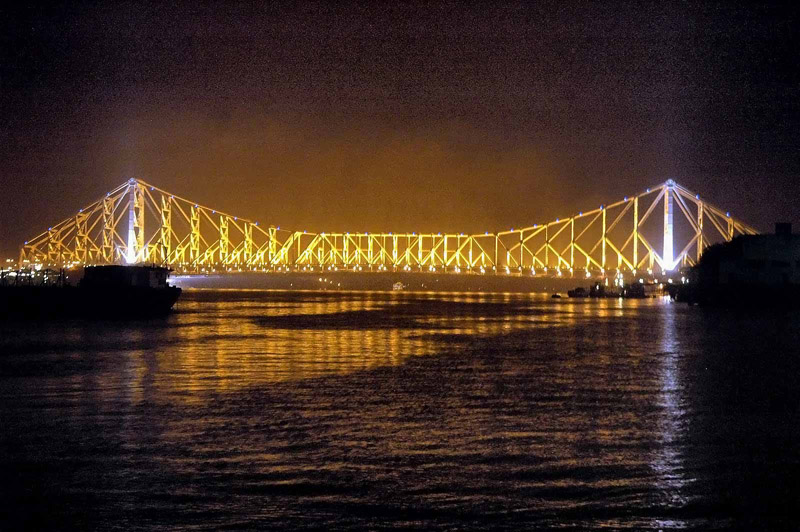
Standing majestically over the Hooghly River, the Howrah Bridge is one of Kolkata’s most recognizable landmarks and one of India’s most celebrated engineering achievements. Connecting Howrah and Kolkata, this enormous steel bridge has been part of the city’s identity for generations.
Officially renamed Rabindra Setu in 1965, the bridge is admired not only for its impressive engineering but also for the extraordinary human activity that surrounds it. Every day, thousands of vehicles and pedestrians cross the bridge, making it an essential part of Kolkata’s urban life.
A Landmark of Engineering
The present Howrah Bridge was constructed during the British era and opened to traffic in 1943. Unlike conventional bridges, its main structure was built as a cantilever bridge, eliminating the need for large supporting piers in the river.
The bridge uses a massive steel framework and was designed to withstand the demands of heavy traffic and the powerful currents of the Hooghly.
Its distinctive steel structure has become one of the defining images of Kolkata.
Connecting Kolkata and Howrah
The bridge provides a vital connection between Kolkata and Howrah, two closely linked urban areas separated by the Hooghly River.
From early morning onward, the bridge becomes a constantly moving stream of buses, cars, taxis, bicycles and pedestrians. The sheer volume of activity gives the bridge a unique energy that reflects Kolkata itself.
For visitors, watching the city move across the bridge can be an experience in its own right.
A Photographer’s Favorite Landmark
Howrah Bridge offers spectacular photographic opportunities throughout the day.
At sunrise, the soft morning light illuminates the steel structure and river below. During the evening, the bridge becomes particularly atmospheric as Kolkata’s skyline and the surrounding riverfront begin to glow.
Views from the Hooghly River, nearby ghats and river cruises provide excellent perspectives of the enormous structure.
Hooghly River and the Ghats
The area surrounding Howrah Bridge is closely connected with the historic riverfront of Kolkata.
The Hooghly River has played an important role in the economic, cultural and commercial development of the city. Traditional boats, ferries and modern vessels continue to move along its waters.
The nearby ghats provide opportunities to observe everyday life along the river, including religious activities, ferry services and traditional practices.
Nearby Attractions
A visit to Howrah Bridge can easily be combined with several other important Kolkata attractions.
Howrah Railway Station
Located close to the bridge on the Howrah side, Howrah Railway Station is one of India’s busiest and most historic railway stations. Its distinctive red facade and enormous scale make it another important landmark in the area.
Mullick Ghat Flower Market
Located beneath the Kolkata end of the bridge, Mullick Ghat Flower Market is one of the city’s most colorful and energetic places.
The market comes alive particularly early in the morning, with traders selling enormous quantities of marigolds, roses and other flowers. The vivid colors, activity and atmosphere provide excellent opportunities for photography and cultural exploration.
New Market and Central Kolkata
Visitors can also explore central Kolkata’s historic markets, colonial architecture, restaurants and cultural attractions after visiting the bridge.
Best Time to Visit
Howrah Bridge can be seen throughout the year, but the cooler months from October to March are generally more comfortable for exploring Kolkata.
For photography, early morning offers beautiful light and a less crowded atmosphere around the riverfront. Evening visits provide a completely different experience as the city begins to light up.
How to Reach Howrah Bridge
Howrah Bridge is extremely accessible because it connects two major transportation hubs.
Howrah Railway Station is immediately adjacent to the bridge on the Howrah side. On the Kolkata side, the bridge connects toward areas including Burrabazar and the northern part of central Kolkata.
Taxis, buses, app-based cabs and other forms of public transport provide convenient access to the surrounding areas.
A Living Part of Kolkata
Unlike many monuments that are preserved primarily as tourist attractions, Howrah Bridge remains an essential piece of Kolkata’s daily infrastructure.
People cross it every day for work, business, education and travel. The constant movement of the city across this historic structure gives it a special character.
It is simultaneously a remarkable engineering achievement, a transportation lifeline and a cultural symbol.
Why Howrah Bridge Is Worth Visiting
Howrah Bridge represents the spirit of Kolkata in a way few other landmarks can. Its enormous steel structure towers above the Hooghly while the city moves continuously across it.
For travelers, the experience is not simply about looking at a bridge. It is about witnessing Kolkata’s history, riverfront culture, architecture and everyday life converge in one extraordinary location.
From the morning bustle of Mullick Ghat to the golden reflections of sunset on the Hooghly, Howrah Bridge remains an unforgettable symbol of Kolkata and one of India’s most iconic landmarks.