


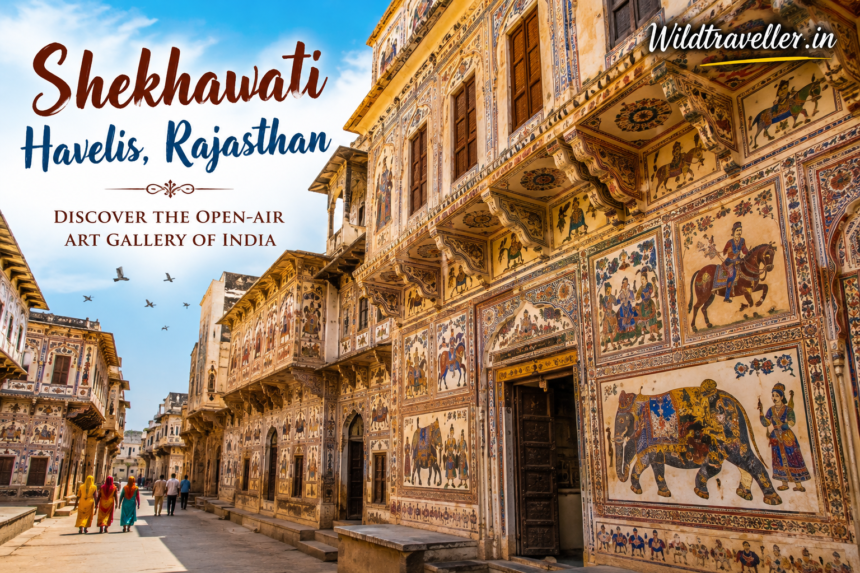
Shekhawati Havelis, Rajasthan: Scattered across the towns and villages of Rajasthan’s Shekhawati region, magnificent havelis decorated with colourful frescoes, ornate balconies and intricate architectural details tell the story of a fascinating era of trade, wealth and artistic expression.
- What Makes Shekhawati Special?
- The Magnificent Frescoes
- Explore Mandawa
- Discover Nawalgarh
- Visit Fatehpur
- Explore Churu
- Discover Dundlod
- The Merchant Families of Shekhawati
- Architecture of a Traditional Haveli
- Shekhawati as an Open-Air Museum
- Best Time to Visit Shekhawati
- How to Reach Shekhawati
- Things to Do in Shekhawati
- Shekhawati for Photography Lovers
- Local Food to Try
- Responsible Heritage Tourism
- Why Visit Shekhawati?
- Final Thoughts
Often described as “the open-air art gallery of Rajasthan,” Shekhawati is an extraordinary destination for travellers interested in history, architecture, art and India’s traditional heritage.
What Makes Shekhawati Special?
The Shekhawati region lies primarily in the northeastern part of Rajasthan and includes historic towns such as Mandawa, Nawalgarh, Fatehpur, Churu, Jhunjhunu and Dundlod.
From the 18th to early 20th centuries, prosperous merchant families built enormous mansions known as havelis.
These buildings were not simply residences. Their walls and ceilings were transformed into canvases covered with colourful paintings depicting religious stories, royal processions, animals, flowers, everyday life and, later, scenes influenced by modern technology.
The Magnificent Frescoes
The most remarkable feature of Shekhawati’s havelis is their fresco artwork.
Traditional paintings cover exterior walls, courtyards, arches and interior rooms. Artists used mineral and natural pigments to create detailed compositions.
Common themes include:
- Hindu gods and goddesses
- Scenes from the Ramayana and Mahabharata
- Maharajas and royal processions
- Elephants and horses
- Flowers and geometric designs
- Village life
- British-era influences
- Trains, cars and bicycles
- Aeroplanes and other early modern inventions
The combination of traditional mythology and modern imagery makes Shekhawati’s frescoes particularly fascinating.
Explore Mandawa
Mandawa is one of the most popular destinations for exploring Shekhawati’s architectural heritage.
The town is filled with beautifully decorated havelis and historic buildings.
Among the notable attractions are:
- Murmu ki Haveli
- Murmuria Haveli
- Jhunjhunwala Haveli
- Goenka Double Haveli
- Mandawa Fort
Walking through Mandawa’s old streets provides an opportunity to discover colourful frescoes almost everywhere you look.
Discover Nawalgarh
Nawalgarh is another important centre of Shekhawati’s heritage.
Founded in the 18th century, the town contains numerous havelis decorated with elaborate murals.
Some notable examples include Anandi Lal Poddar Haveli and Aath Haveli, among other historic residences.
Nawalgarh is particularly interesting for visitors who want to explore the artistic traditions of the region without limiting their trip to Mandawa.
Visit Fatehpur
Fatehpur is known for its impressive collection of historic havelis and frescoes.
One of its best-known attractions is Nadine Le Prince Cultural Centre, housed in a restored haveli.
The town also contains numerous old merchant mansions and beautifully painted buildings.
Fatehpur is an excellent stop for travellers exploring the northern part of the Shekhawati circuit.
Explore Churu
The historic town of Churu is another important destination in the Shekhawati region.
Its old neighbourhoods contain traditional havelis with elaborate wall paintings.
The Kanhaiya Lal Bagla Haveli and other heritage buildings showcase the artistic traditions that made the region famous.
Churu’s old streets are particularly rewarding for photographers interested in architecture and street scenes.
Discover Dundlod
Located between Nawalgarh and Jhunjhunu, Dundlod is known for its fort, havelis and traditional architecture.
The town has a quieter atmosphere than some of the more frequently visited Shekhawati destinations.
Dundlod Fort is an important heritage landmark, while the surrounding havelis provide further examples of the region’s distinctive artistic style.
The Merchant Families of Shekhawati
Shekhawati’s extraordinary architecture is closely connected to the history of India’s merchant communities.
Many wealthy trading families from the region established businesses in major commercial centres across India and accumulated significant wealth.
They invested some of their fortunes in their hometowns, constructing impressive mansions decorated with elaborate paintings and architectural details.
Over time, many families moved away from the region, leaving behind the remarkable havelis that visitors can see today.
Architecture of a Traditional Haveli
A traditional Shekhawati haveli was designed around one or more courtyards.
The courtyard provided light, ventilation and a private gathering space for the family.
Typical architectural features include:
- Large entrance gates
- Ornamental balconies
- Carved wooden doors
- Decorative arches
- Internal courtyards
- Fresco-covered walls
- Jharokhas
- Intricate stone and plasterwork
The combination of practical design and artistic decoration gives these mansions their distinctive character.
Shekhawati as an Open-Air Museum
Unlike a conventional museum where artworks are displayed inside galleries, Shekhawati’s art is integrated into the towns themselves.
A simple walk through an old neighbourhood can reveal:
- Faded frescoes
- Elaborate doorways
- Carved balconies
- Historic mansions
- Small temples
- Old merchant residences
This makes exploring Shekhawati feel like travelling through a giant open-air museum.
Best Time to Visit Shekhawati
The best time to explore Shekhawati is October to March, when temperatures are more comfortable.
November to February is particularly pleasant for walking tours and heritage sightseeing.
Summer temperatures can become extremely high, making long walks through the towns uncomfortable.
The monsoon brings some greenery but is generally less popular for heritage tourism.
How to Reach Shekhawati
By Air
The nearest major airport is Jaipur International Airport, which provides connections to many Indian cities.
From Jaipur, visitors can continue to Shekhawati by road or train.
By Train
Several Shekhawati towns have railway connections. Jhunjhunu, Nawalgarh and Churu can be reached by rail depending on the route.
By Road
Shekhawati is well connected by road with Jaipur, Delhi and other cities in Rajasthan.
A road trip is an excellent way to explore several towns because many attractions are spread across the region.
Things to Do in Shekhawati
A heritage trip through Shekhawati can include:
- Explore historic havelis
- Photograph colourful frescoes
- Visit Mandawa Fort
- Explore Nawalgarh’s old streets
- Visit Fatehpur
- Discover Churu’s heritage buildings
- Explore Dundlod Fort
- Stay in a restored heritage haveli
- Experience traditional Rajasthani cuisine
- Shop for local handicrafts
- Meet local artists and residents
Shekhawati for Photography Lovers
Shekhawati is a paradise for photographers.
The combination of faded frescoes, colourful architecture, carved doors, narrow streets and desert light creates endless photographic opportunities.
Morning and late afternoon provide softer natural light and are ideal for architectural photography.
A wide-angle lens can be useful for capturing the full scale of the havelis, while a telephoto or standard lens can highlight individual fresco details.
Local Food to Try
While exploring Shekhawati, travellers can enjoy traditional Rajasthani cuisine such as:
- Dal Baati Churma
- Gatte ki Sabzi
- Ker Sangri
- Bajra roti
- Pyaaz kachori
- Mirchi vada
- Traditional Rajasthani sweets
- Chai and local snacks
Heritage hotels and local restaurants often provide opportunities to experience regional cooking.
Responsible Heritage Tourism
Many Shekhawati havelis are privately owned or are fragile historic structures.
Visitors should:
- Avoid touching or damaging frescoes.
- Respect private property.
- Ask permission before entering privately owned havelis.
- Avoid writing or carving on walls.
- Support local guides and heritage businesses.
- Purchase local handicrafts where possible.
- Respect residents living within historic neighbourhoods.
Responsible tourism can help preserve these architectural treasures.
Why Visit Shekhawati?
Shekhawati offers a travel experience that is very different from Rajasthan’s famous palace cities.
Instead of focusing only on grand forts and royal residences, visitors discover the homes, art and stories of the region’s historic merchant communities.
Every haveli can reveal something different — from religious paintings and royal scenes to fascinating depictions of early cars, trains and aeroplanes.
Final Thoughts
The Shekhawati Havelis are among Rajasthan’s greatest hidden treasures.
Their colourful frescoes, magnificent courtyards, carved doors and elaborate architecture provide a fascinating glimpse into the region’s prosperous past.
Whether you are an architecture enthusiast, history lover, art collector, photographer or simply a curious traveller, exploring Shekhawati is like stepping into a living gallery spread across the heart of Rajasthan.
Walk through the old streets, admire the fading frescoes and discover the artistic legacy of Shekhawati — Rajasthan’s remarkable open-air art gallery.