

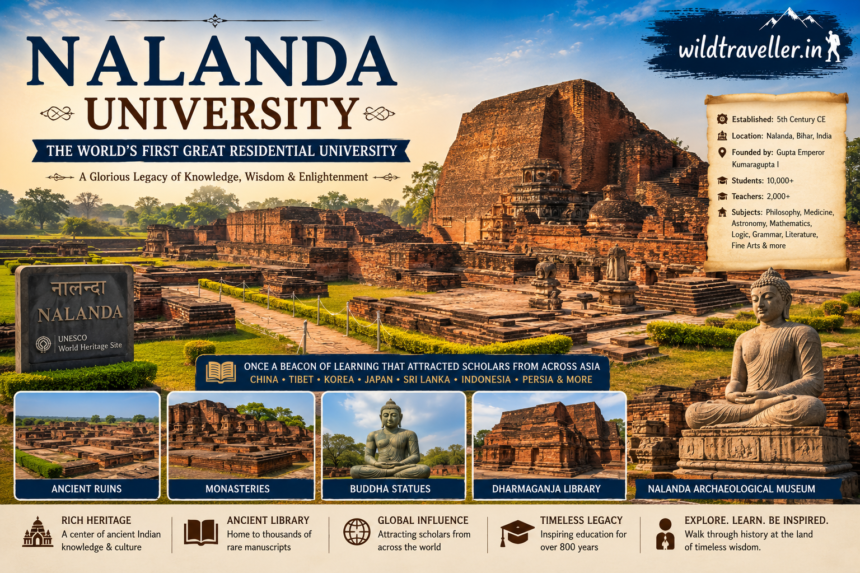
Nalanda, Bihar: Nalanda University stands as one of the greatest symbols of ancient India’s intellectual and cultural heritage. Located in the historic district of Nalanda in Bihar, this legendary center of learning flourished for nearly 800 years and attracted scholars, monks, and students from across Asia. Widely regarded as one of the world’s first residential universities, Nalanda played a pivotal role in the development of education, philosophy, science, medicine, mathematics, and Buddhist studies.
Today, the ancient ruins of Nalanda are a UNESCO World Heritage Site, while the modern Nalanda University continues the legacy of international education and academic excellence.
A Glorious History
Nalanda University was established during the 5th century CE, most likely under the patronage of Gupta Emperor Kumaragupta I. It soon became one of the world’s most prestigious centers of higher learning, flourishing under successive Gupta, Harsha, and Pala rulers.
For centuries, Nalanda attracted scholars from countries including:
- China
- Tibet
- Korea
- Japan
- Sri Lanka
- Indonesia
- Thailand
- Mongolia
- Persia
The university remained a beacon of knowledge until the 12th century, when it suffered destruction during invasions, leading to the loss of countless priceless manuscripts and ancient texts.
The World’s First Residential University
Nalanda was far ahead of its time. It provided:
- Residential hostels for thousands of students
- Large lecture halls
- Meditation centers
- Libraries
- Gardens
- Monasteries
- Research facilities
Historical records suggest that the university accommodated nearly 10,000 students and over 2,000 teachers, making it one of the largest educational institutions of the ancient world.
Subjects Taught at Nalanda
The curriculum at Nalanda extended far beyond Buddhist philosophy. Students studied:
- Buddhist Philosophy
- Hindu Scriptures
- Logic
- Grammar
- Sanskrit
- Mathematics
- Astronomy
- Medicine (Ayurveda)
- Literature
- Fine Arts
- Architecture
- Political Science
- Ethics
Admission standards were exceptionally rigorous, with only a small percentage of applicants successfully gaining entry.
The Great Library – Dharmaganja
Nalanda’s legendary library, known as Dharmaganja (Treasury of Truth), was among the largest libraries in the ancient world.
It consisted of three magnificent buildings:
- Ratnasagara
- Ratnodadhi
- Ratnaranjaka
The library reportedly housed hundreds of thousands of manuscripts covering religion, science, medicine, mathematics, philosophy, and literature.
According to historical accounts, the library burned for several months after the university’s destruction due to the vast number of manuscripts stored within.
Xuanzang and Other Famous Scholars
One of Nalanda’s most celebrated students was the Chinese Buddhist monk Xuanzang (Hsuan Tsang), who studied and taught at the university during the 7th century.
His detailed travel accounts provide valuable insights into Nalanda’s educational system, campus life, and academic excellence.
Another renowned scholar associated with Nalanda was Yijing, who also documented the university’s traditions and influence.
UNESCO World Heritage Site
In 2016, the Archaeological Site of Nalanda Mahavihara was inscribed as a UNESCO World Heritage Site in recognition of its outstanding historical and cultural significance.
Visitors today can explore:
- Ancient monasteries
- Lecture halls
- Temple complexes
- Meditation chambers
- Brick structures
- Stone sculptures
- Archaeological remains
Nalanda Archaeological Museum
Located near the ruins, the Nalanda Archaeological Museum houses an impressive collection of:
- Buddha statues
- Bronze sculptures
- Terracotta artifacts
- Ancient inscriptions
- Coins
- Pottery
- Stone carvings
The museum offers valuable insight into the university’s glorious past.
Modern Nalanda University
Inspired by the legacy of the ancient institution, the modern Nalanda University was established near the historic site as an international university dedicated to research, sustainability, Buddhist studies, ecology, history, and international relations.
It continues to welcome students and scholars from around the world, carrying forward Nalanda’s centuries-old tradition of global learning.
Best Time to Visit
The ideal time to visit Nalanda is between October and March, when the weather is pleasant for exploring the archaeological site.
- Winter (October–February): Best season
- Summer (March–June): Hot afternoons
- Monsoon (July–September): Lush greenery with occasional rainfall
How to Reach
By Air
The nearest airport is Jay Prakash Narayan International Airport, Patna, approximately 90 km away.
By Rail
The nearest railway station is Rajgir, about 12 km from Nalanda. Major rail connectivity is available through Bakhtiyarpur Junction and Patna Junction.
By Road
Nalanda is well connected by road with:
- Patna
- Rajgir
- Bodh Gaya
- Gaya
- Bihar Sharif
Regular buses, taxis, and private vehicles are available.
Nearby Attractions
Rajgir (12 km)
An ancient city associated with Lord Buddha and Mahavira, famous for the Vishwa Shanti Stupa, Gridhakuta Hill, and Ropeway.
Bodh Gaya (85 km)
The sacred place where Lord Buddha attained enlightenment, featuring the UNESCO-listed Mahabodhi Temple.
Pawapuri (26 km)
A major Jain pilgrimage destination where Lord Mahavira attained Nirvana.
Bihar Sharif
Known for historical monuments, mosques, and cultural heritage.
Travel Tips
- Wear comfortable walking shoes while exploring the ruins.
- Carry drinking water and sunscreen during warmer months.
- Visit the archaeological museum for a deeper understanding of Nalanda’s history.
- Hire a certified guide for detailed historical insights.
- Photography is allowed in most outdoor areas.
- Respect the archaeological site’s heritage by avoiding littering or climbing on protected structures.
Why Visit Nalanda University?
Nalanda University is more than an ancient educational institution—it is a timeless symbol of India’s rich intellectual tradition and its contributions to global knowledge. Walking through its centuries-old ruins offers a glimpse into a civilization that valued learning, dialogue, and cultural exchange.
Whether you are a history enthusiast, student, spiritual traveler, or cultural explorer, Nalanda promises an inspiring journey through one of the world’s greatest centers of education.