



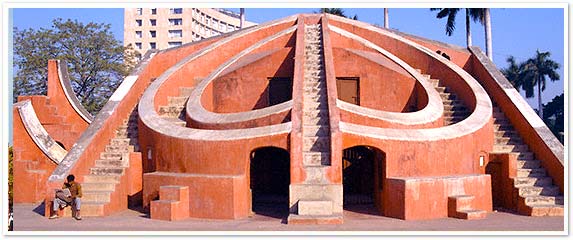
Jantar Mantar is one of India’s most fascinating scientific and architectural landmarks. The name is most commonly associated with the famous astronomical observatories built during the 18th century by Maharaja Sawai Jai Singh II, a ruler of Jaipur who had a deep interest in astronomy and mathematics.
These remarkable structures demonstrate how Indian scholars and rulers used monumental instruments to observe the movement of the Sun, Moon, planets, and stars.
The Vision of Sawai Jai Singh II
Maharaja Sawai Jai Singh II was not only a ruler but also a keen student of astronomy. He commissioned a series of observatories to improve astronomical calculations and observations.
The most famous Jantar Mantar is located in Jaipur, Rajasthan, although Jai Singh also established observatories in other cities, including Delhi, Ujjain, Varanasi, and Mathura.
The Jaipur observatory remains the largest and best preserved among these historic sites.
Giant Instruments for Studying the Sky
The instruments at Jantar Mantar may look like unusual architectural sculptures, but they were carefully designed for scientific observation.
They were used to measure time, track celestial objects, determine astronomical positions, and assist with calculations related to calendars and astrology.
The scale of the instruments allowed astronomers to make observations with greater precision than many smaller instruments of the period.
The Famous Samrat Yantra
One of the most impressive instruments at Jantar Mantar is the Samrat Yantra, a massive sundial.
Its enormous triangular structure acts as a gnomon, casting a shadow that can be used to measure solar time. The instrument is among the largest sundials of its kind and remains one of the site’s most recognizable attractions.
Other Fascinating Instruments
Jantar Mantar contains numerous specialized astronomical instruments, each designed for a particular purpose.
Some instruments were used to measure the altitude and position of celestial bodies, while others helped determine the coordinates of astronomical objects.
The Jai Prakash Yantra and Ram Yantra are among the other well-known structures that demonstrate the sophisticated understanding of astronomy behind the observatory’s design.
A Blend of Science and Architecture
What makes Jantar Mantar particularly remarkable is the way science and architecture are combined. The instruments are monumental structures constructed from masonry rather than conventional handheld scientific devices.
Their geometric forms create a visually striking environment while serving practical astronomical functions.
The observatory reflects the scientific traditions of 18th-century India and the exchange of astronomical knowledge between different cultures.
UNESCO World Heritage Recognition
The Jantar Mantar in Jaipur was designated a UNESCO World Heritage Site in 2010. The observatory is recognized as an outstanding example of historical astronomical observation and scientific architecture.
Today, it remains one of Jaipur’s most important tourist attractions and a valuable reminder of India’s rich scientific heritage.
Best Time to Visit
The best time to visit Jantar Mantar in Jaipur is generally between October and March, when the weather is more comfortable for exploring the outdoor observatory.
Early morning or late afternoon can be particularly pleasant for sightseeing and photography.
Nearby Attractions
Jantar Mantar is conveniently located near several of Jaipur’s most famous landmarks. Visitors can combine their trip with the City Palace and the famous Hawa Mahal.
Exploring these attractions together provides an excellent introduction to Jaipur’s royal history, architecture, and cultural heritage.
A Monument to India’s Scientific Heritage
Jantar Mantar is much more than a collection of unusual structures. It is a remarkable monument to human curiosity and the desire to understand the universe.
The giant sundials and astronomical instruments demonstrate the advanced scientific knowledge and architectural creativity of their time. For travelers interested in science, history, architecture, or astronomy, Jantar Mantar offers a fascinating journey into India’s remarkable intellectual heritage.