
Hidden among the rocky hills and forests of Madhya Pradesh, Bhimbetka is one of India’s most fascinating archaeological destinations. Famous for its ancient rock shelters and prehistoric paintings, the site offers visitors a remarkable glimpse into the lives of some of the earliest human communities on the Indian subcontinent.
- Why Visit Bhimbetka?
- Rock Shelters of Bhimbetka
- Prehistoric Rock Paintings
- What Do the Paintings Tell Us?
- Natural Rock Formations
- The Archaeological Importance of Bhimbetka
- Bhimbetka and the UNESCO World Heritage Site
- The Connection with the Mahabharata
- Bhojpur Temple – A Nearby Attraction
- Bhopal – The Ideal Base for Bhimbetka
- Best Time to Visit Bhimbetka
- How to Reach Bhimbetka
- Suggested One-Day Bhimbetka Itinerary
- Travel Tips for Bhimbetka
- Protecting Bhimbetka’s Ancient Heritage
- Who Should Visit Bhimbetka?
- Final Thoughts
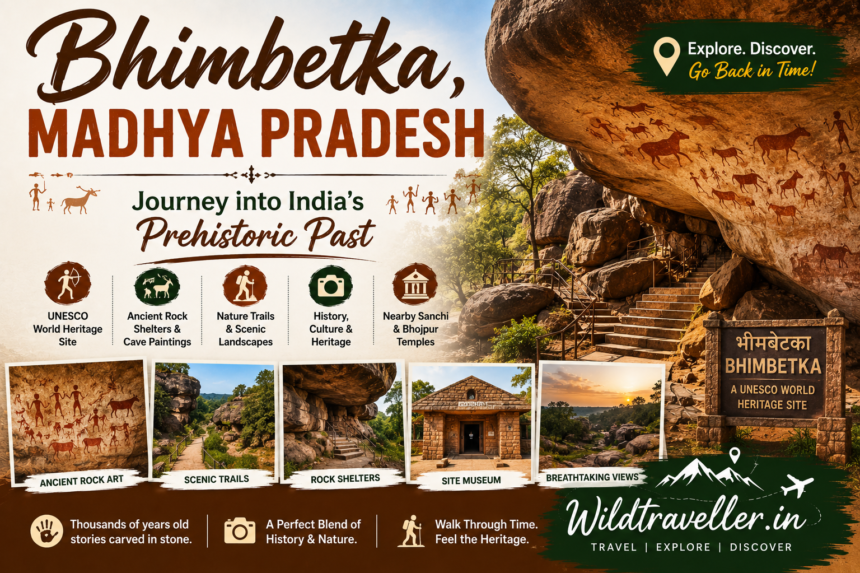
Located in Raisen district, about 45 kilometres southeast of Bhopal, the Rock Shelters of Bhimbetka are recognised as a UNESCO World Heritage Site. The shelters preserve hundreds of rock paintings and archaeological evidence spanning a vast period of human history.
For travellers interested in archaeology, history, photography, nature, and ancient cultures, Bhimbetka is an extraordinary destination.
Why Visit Bhimbetka?
Bhimbetka is very different from conventional tourist destinations.
The site is famous for:
- Prehistoric rock paintings
- Ancient rock shelters
- Stone tools and archaeological remains
- Mesolithic and later cultural evidence
- Natural sandstone formations
- Forest landscapes
- Ancient human settlements
- UNESCO World Heritage status
Walking through the shelters provides an unusual opportunity to see artwork created thousands of years ago in the same landscapes where prehistoric communities once lived.
Rock Shelters of Bhimbetka
The Rock Shelters of Bhimbetka are the main attraction.
The site contains hundreds of sandstone shelters, many of which preserve paintings and other evidence of human activity.
The paintings depict scenes from everyday life, including:
- Hunting
- Dancing
- Animals
- Group activities
- Rituals
- Weapons
- Hunting tools
- Human figures
The artwork provides valuable clues about the lives, environment, and beliefs of ancient communities.
Prehistoric Rock Paintings
One of the most remarkable aspects of Bhimbetka is the variety of rock art found across the shelters.
Paintings include depictions of animals such as deer, bison, elephants, wild boar, and other creatures.
Human figures are often shown carrying weapons or participating in group activities.
The paintings were created over different periods, meaning that not all artwork belongs to the same historical era.
Some paintings are believed to date back many thousands of years, while others belong to later prehistoric and historic periods.
What Do the Paintings Tell Us?
The rock art provides a visual record of prehistoric life.
Scenes of hunting suggest how early communities interacted with the surrounding environment.
Dancing and group scenes may provide clues about social and cultural practices.
The presence of animals reflects the biodiversity that existed in the region at different points in history.
Although researchers continue to study the paintings, they offer a fascinating window into humanity’s distant past.
Natural Rock Formations
Bhimbetka is not only an archaeological site—it is also a beautiful natural landscape.
The shelters are surrounded by sandstone hills, rocky outcrops, forests, and valleys.
Some rock formations have unusual shapes that appear almost like animals or architectural structures.
The natural environment helps explain why prehistoric communities may have chosen these shelters for habitation and protection.
The Archaeological Importance of Bhimbetka
Bhimbetka provides evidence of human occupation extending across a very long period.
Archaeological discoveries at the site include stone tools, habitation evidence, and other remains associated with different stages of prehistoric development.
The shelters therefore provide more than ancient artwork—they represent an important archaeological record of human life.
The site has helped researchers understand how early human communities lived, hunted, adapted to their environment, and developed artistic traditions.
Bhimbetka and the UNESCO World Heritage Site
The Rock Shelters of Bhimbetka were added to the UNESCO World Heritage List in 2003.
The designation recognises the site’s outstanding archaeological importance and the exceptional record it provides of prehistoric human life.
Bhimbetka is considered one of the most important concentrations of prehistoric rock art in South Asia.
The Connection with the Mahabharata
The name Bhimbetka is traditionally associated with Bhima, one of the Pandava brothers from the Mahabharata.
Local traditions connect the rocky landscape with the legendary figure.
However, the archaeological evidence at Bhimbetka belongs to prehistoric and historic periods that are distinct from these later epic traditions.
The connection adds an interesting layer of mythology to an already remarkable archaeological destination.
Bhojpur Temple – A Nearby Attraction
Travellers visiting Bhimbetka can combine their trip with a visit to Bhojpur, located in the surrounding region.
The Bhojeshwar Temple, dedicated to Lord Shiva, is famous for its enormous Shiva lingam and unfinished temple architecture.
The monument is traditionally associated with King Bhoja of the Paramara dynasty.
Its unfinished construction makes it particularly interesting to visitors interested in medieval architecture.
Bhopal – The Ideal Base for Bhimbetka
Bhopal, the capital of Madhya Pradesh, is the most convenient major city from which to explore Bhimbetka.
The city itself has several attractions, including:
- Upper Lake
- Lower Lake
- Madhya Pradesh Tribal Museum
- State Museum
- Taj-ul-Masajid
- Van Vihar National Park
- Old Bhopal markets
A Bhimbetka day trip can easily be combined with sightseeing in Bhopal.
Best Time to Visit Bhimbetka
October to February
The winter months are generally the most comfortable for exploring the rock shelters.
The cooler temperatures make walking between the shelters easier.
March to May
Summer temperatures can become high, especially during the afternoon.
Visitors should carry plenty of water and plan their visit during cooler hours.
June to September
The monsoon transforms the surrounding landscape into a lush green environment.
However, rainfall can make rocky surfaces slippery, so visitors should exercise caution.
How to Reach Bhimbetka
By Air
The nearest airport is Raja Bhoj Airport in Bhopal.
From Bhopal, Bhimbetka can be reached by road.
By Train
Bhopal Junction is the nearest major railway station with connections to many cities across India.
By Road
Bhimbetka is accessible by road from Bhopal and nearby towns.
The site can be comfortably included in a day trip from Bhopal.
Suggested One-Day Bhimbetka Itinerary
Morning
Leave Bhopal early and travel towards Bhimbetka.
Arrive at the archaeological site and begin exploring the designated rock shelters.
Late Morning
Spend time examining the prehistoric paintings and natural rock formations.
Take your time rather than rushing between shelters.
Afternoon
Have lunch and, if time permits, visit nearby Bhojpur Temple.
Return to Bhopal in the evening.
Travel Tips for Bhimbetka
- Wear comfortable walking shoes.
- Carry drinking water.
- Wear a hat and sunscreen during summer.
- Follow designated paths.
- Do not touch or scratch the rock paintings.
- Do not use flash photography if prohibited.
- Avoid littering.
- Follow instructions from site authorities.
- Keep children supervised around rocky areas.
- Check opening hours and visitor rules before travelling.
Protecting Bhimbetka’s Ancient Heritage
The paintings at Bhimbetka have survived for thousands of years, but they remain vulnerable.
Visitors should never touch the artwork, write on the rocks, or attempt to remove stones or archaeological materials.
Even small amounts of physical contact can contribute to the deterioration of ancient paintings.
Responsible tourism is essential to ensure that future generations can experience these remarkable traces of prehistoric human creativity.
Who Should Visit Bhimbetka?
Bhimbetka is an excellent destination for:
- History enthusiasts
- Archaeology students
- Families
- Photographers
- Nature lovers
- School and educational trips
- Heritage travellers
- Anyone interested in prehistoric human history
Children can find the animal paintings particularly fascinating, while history enthusiasts can spend hours studying the shelters and their archaeological significance.
Final Thoughts
Bhimbetka, Madhya Pradesh, offers one of the rare opportunities to step into the distant past without visiting a conventional museum.
Its ancient rock shelters, prehistoric paintings, stone tools, dramatic sandstone formations, and surrounding forests create a remarkable connection between the modern traveller and some of India’s earliest human communities.
Combined with nearby Bhojpur and Bhopal, Bhimbetka can become an enriching addition to a Madhya Pradesh itinerary.
For anyone fascinated by prehistoric India, ancient rock art, archaeology, and human history, Bhimbetka is a destination that deserves a place on the travel list.