



Jantar Mantar in Jaipur is one of India’s most fascinating historical landmarks and a remarkable example of scientific knowledge from the 18th century. Built by Maharaja Sawai Jai Singh II between 1727 and 1734, the observatory was created to study the movements of the sun, moon, planets, and stars with remarkable precision.
Located near the City Palace in the heart of Jaipur, Jantar Mantar contains a collection of large astronomical instruments constructed primarily from stone and masonry. These instruments were designed to measure time, observe celestial bodies, determine the position of stars and planets, and calculate important astronomical events.
A Legacy of Astronomy
Maharaja Sawai Jai Singh II was deeply interested in astronomy and mathematics. He established several observatories across India, including those in Delhi, Ujjain, Mathura, Varanasi, and Jaipur. The Jaipur observatory is the largest and best-preserved of these.
At a time when modern telescopes and electronic instruments did not exist, the massive structures at Jantar Mantar provided astronomers with practical tools for making detailed celestial observations.
The Famous Samrat Yantra
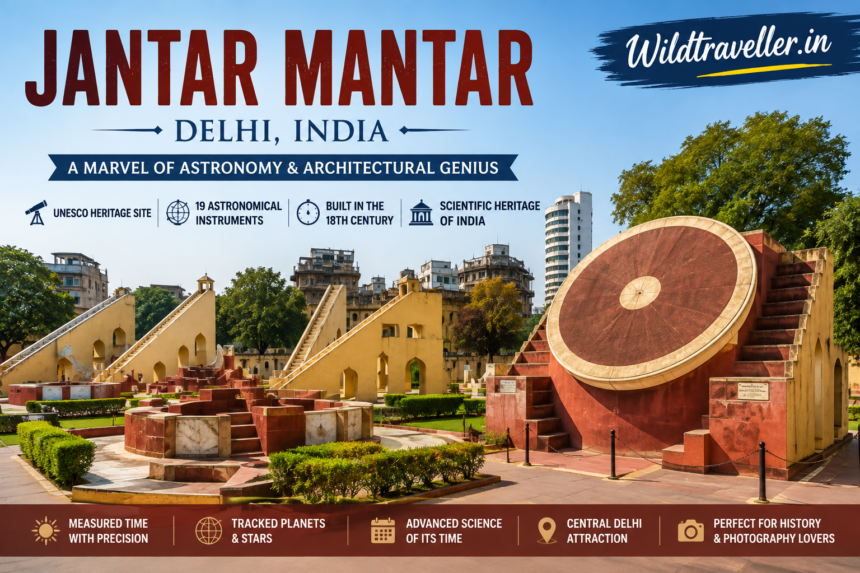
One of the most impressive structures at Jantar Mantar is the Samrat Yantra, often described as the world’s largest stone sundial. Its enormous triangular structure and carefully designed scale allow visitors to observe the movement of the sun and determine local solar time.
The instrument demonstrates how architecture, mathematics, and astronomy were combined to create highly accurate scientific instruments.
Other Important Instruments
Jantar Mantar contains around 20 major astronomical instruments. Among them are the Jai Prakash Yantra, which helps determine the position of celestial objects; the Ram Yantra, used to measure the altitude and azimuth of celestial bodies; and the Narivalaya Yantra, which was designed for measuring time.
Each instrument has a specific purpose, and together they provide an insight into the sophisticated astronomical techniques used centuries ago.
A UNESCO World Heritage Site
Jantar Mantar, Jaipur, was declared a UNESCO World Heritage Site in 2010. UNESCO recognized the observatory as an outstanding example of astronomical innovation and scientific advancement in the pre-modern world.
Today, it attracts travelers, history enthusiasts, students, photographers, and anyone interested in science and architecture.
Best Time to Visit
The cooler months from October to March are generally considered a comfortable time to explore Jantar Mantar and other attractions in Jaipur. Visiting during the morning or late afternoon can make the experience more pleasant, particularly during warmer months.
Visitors should allow at least one to two hours to explore the observatory and understand the purpose of its different instruments.
Jantar Mantar and Jaipur Tourism
Jantar Mantar is located close to several major Jaipur attractions, including the City Palace and Hawa Mahal. It can therefore be easily included in a sightseeing itinerary covering Jaipur’s historic center.
Beyond its impressive structures, Jantar Mantar offers something different from a typical historical monument. It represents India’s long-standing tradition of scientific observation and shows how ancient and early-modern astronomers used mathematics and architectural precision to understand the universe.
Conclusion
Jantar Mantar is more than an architectural attraction—it is a monument to India’s scientific heritage. Its enormous astronomical instruments demonstrate the remarkable understanding of mathematics, astronomy, and engineering that existed in 18th-century India.
For travelers visiting Jaipur, a visit to Jantar Mantar provides an opportunity to experience history from a scientific perspective and appreciate the ingenuity behind one of India’s most extraordinary astronomical observatories.