


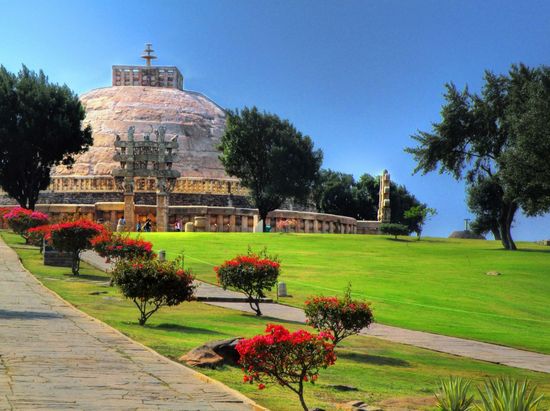
Located in Madhya Pradesh, the Buddhist Monuments at Sanchi are among India’s most important surviving examples of ancient Buddhist architecture, art and religious history. Rising from a hilltop near the town of Sanchi, this remarkable archaeological complex preserves stupas, temples, monasteries, pillars and beautifully carved gateways dating from different periods of Indian history.
Recognized as a UNESCO World Heritage Site, Sanchi offers visitors an extraordinary glimpse into the development and spread of Buddhism in the Indian subcontinent.
A Historic Buddhist Centre
Sanchi’s history dates back to the 3rd century BCE, when Emperor Ashoka, one of the most influential rulers associated with the spread of Buddhism, established a Buddhist presence at the site.
The Great Stupa was later enlarged and transformed, particularly during the Shunga period, while additional monuments were constructed and decorated over subsequent centuries.
Unlike some Buddhist sites that are closely associated with events from the life of Buddha, Sanchi is especially significant because it developed as a major center for Buddhist worship, architecture and artistic expression.
The Great Stupa
The most famous monument at Sanchi is Stupa 1, commonly known as the Great Stupa.
Originally commissioned during the Mauryan period, the structure was subsequently enlarged and extensively embellished. Its massive hemispherical dome, known as an anda, represents one of the defining architectural forms of Buddhist sacred architecture.
At the top are the harmika and chhatra, symbolic elements associated with Buddhist cosmology and spiritual significance.
The stupa was designed as a sacred monument for circumambulation, allowing devotees to walk around it in a clockwise direction as part of Buddhist worship.
The Four Magnificent Gateways
Perhaps the most extraordinary artistic features of Sanchi are the four toranas, or gateways, surrounding the Great Stupa.
Located at the north, south, east and west, these gateways are covered with detailed carvings depicting scenes connected with Buddhist traditions.
The sculptures portray Jataka stories, symbolic representations of Buddha, scenes from Buddhist mythology, animals, trees, royal processions and everyday life.
One remarkable feature is that Buddha is generally represented symbolically rather than in human form in many of the early carvings. Symbols such as the Bodhi tree, footprints, the Dharma wheel and an empty throne represent the Buddha and important events associated with his life.
These carvings also provide valuable insights into the clothing, architecture, transportation, social life and artistic traditions of ancient India.
Ashoka Pillar
Another important monument at Sanchi is the Ashoka Pillar, erected during the reign of Emperor Ashoka.
The polished stone pillar demonstrates the remarkable craftsmanship of the Mauryan period. Its design reflects the sophistication of ancient Indian stone-working techniques and the importance of pillars in Buddhist architecture.
Other Monuments at Sanchi
The archaeological complex contains numerous monuments beyond the Great Stupa. These include Stupa 2 and Stupa 3, ancient temples, monasteries, votive structures and other architectural remains.
Temple 17, generally dated to the Gupta period, is particularly important in the history of Indian temple architecture. Its simple yet elegant design represents an early stage in the development of the structural temple tradition.
Stupa 3 is also significant and is associated with relics of two of Buddha’s principal disciples, Sariputta and Mahamoggallana.
Sanchi Museum
Visitors can learn more about the site’s history and archaeological discoveries at the Sanchi Archaeological Museum.
The museum houses sculptures, architectural fragments and other artifacts discovered during excavations at Sanchi. It provides useful context for understanding the monuments and the artistic traditions represented throughout the complex.
Sanchi and Buddhist Heritage
Sanchi is particularly valuable because it demonstrates how Buddhist architecture and artistic traditions developed over many centuries.
The site also illustrates the transformation of Buddhist art from early symbolic representation toward later traditions in which Buddha was increasingly depicted in human form.
The monuments therefore serve not only as religious structures but also as an important historical record of India’s artistic and architectural evolution.
Best Time to Visit Sanchi
The most comfortable period for exploring Sanchi is generally October to March, when temperatures are relatively pleasant.
Visitors should allow several hours to explore the hilltop complex properly. Early morning and late afternoon can be particularly enjoyable for sightseeing and photography.
How to Reach Sanchi
Sanchi is located close to Bhopal, the capital of Madhya Pradesh. The site is approximately 50 kilometres from Bhopal and can be reached by road or rail.
The nearest airport is Raja Bhoj Airport in Bhopal. Sanchi also has a railway station, making it accessible from other parts of Madhya Pradesh and India.
Why Sanchi Is Worth Visiting
The Buddhist Monuments at Sanchi are far more than ancient stone structures. They represent centuries of Indian history, Buddhist philosophy, architectural innovation and artistic excellence.
The magnificent Great Stupa, intricately carved toranas, ancient temples and historic pillars together create a remarkable cultural landscape.
For history enthusiasts, architecture lovers, spiritual travelers and anyone interested in India’s ancient heritage, Sanchi is a destination that offers a rare connection with more than two thousand years of Indian civilization.
A visit to Sanchi is a journey through stone, symbolism and history—where every gateway and monument tells a story of India’s enduring Buddhist heritage.